Climb Ranked Flex Faster as a 5-Stack

Your 5-stack wins Scrims. You talk on Discord. You all have decent solo queue ranks. Yet, when you queue up for Ranked Flex, the results feel random, and the climb is frustratingly slow. This is a common experience for even the most enthusiastic groups. Climbing in the Flex queue as a coordinated five requires a different approach than solo play or casual premades. It demands systems, not just skill. This guide breaks down the practical frameworks used by teams that consistently turn coordination into rank. You'll learn how to structure your communication, build a cohesive champion pool, and design strategies that generate wins before the loading screen even finishes. The core difference between a group of five players and a real Flex team often comes down to one thing: predictable processes. To go deeper, you can also read Optimizing Team Climb During Ranked Resets: Strategies for Flex 5 Efficiency.
Define Your Team's Identity Before You Queue
The first loss of a play session often starts with a vague "what do we want to play?" in champion select. Without a pre-defined identity, draft becomes a series of individual compromises. A strong team identity answers two questions: how do we want to win games, and what are our non-negotiable playstyles? This isn't about copying a pro meta. It's about aligning your five players' instincts into a coherent strategy. To go deeper, you can also read Find Ranked Flex Teammates You Can Queue With.
The Three Core Win Conditions for Flex Teams
Most successful Flex teams simplify their approach by committing to one primary win condition. Trying to master all three dilutes practice and creates mid-game confusion. The first, and most common for new teams, is teamfighting. This identity prioritizes champions with strong, reliable crowd control and area-of-effect damage. Your draft goal is to reach mid-game with a composition that wins a straight 5v5. The game plan is simple: group and take fights where your ultimates are strongest.
The second identity is split-pushing and map pressure. This requires high trust and map awareness. Your composition features at least two strong sidelane duelists. The goal is to avoid clean 5v5s, instead creating impossible choices for the enemy by applying simultaneous pressure. Success here lives and dies on vision control and disciplined rotations, not mechanical outplays.
The third identity is early snowball and objective rush. This is for aggressive, communicative teams. You draft for early lane priority and 2v2 or 3v3 skirmish power. The game plan is to secure the first Herald, use it to crack open a tier-two turret before 14 minutes, and choke the enemy out with relentless objective takes. The risk is that a failed early play can leave you without the scaling for late-game.
In our review sessions with teams, the single biggest predictor of a stalled climb is an inconsistent win condition. A team will win a slow, scaling game one match, then try to force early fights in the next. Pick one identity that suits your collective temperament and stick with it for at least twenty games. Consistency in approach breeds consistency in results.
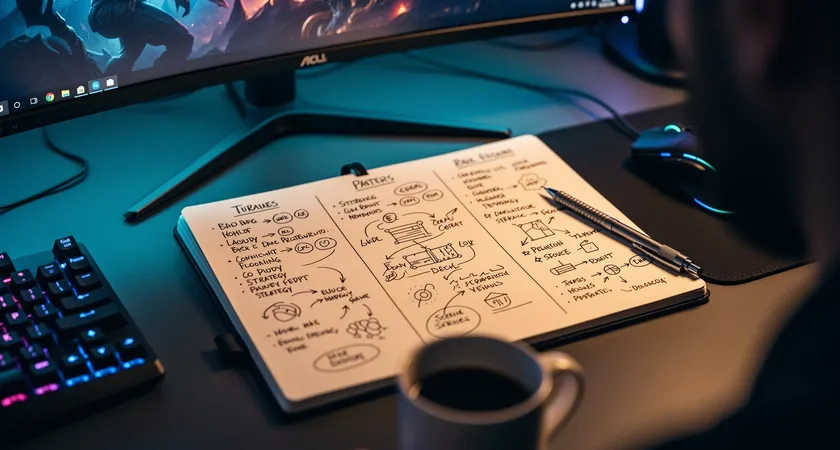
Build a Shotcalling System, Not Just a Shotcaller
Relying on one charismatic leader to make every call is a classic bottleneck. When that player has a bad game or gets flustered, the entire team's decision-making collapses. The solution is to distribute responsibility across different phases of the game. Think of it as building a playbook with designated play-callers for specific situations. This reduces mental load and prevents the common "too many cooks" noise during critical moments.
Start by designating an early game leader. This is often your jungler or a support player with strong map awareness. Their sole focus is the first 15 minutes: tracking the enemy jungler, calling for invades, signaling gank timings, and prioritizing the first Dragon or Herald. Their voice should be the primary one during this phase, with others providing concise information, not debate.
Separately, designate a late-game and teamfight caller. This is typically your mid-laner or ADC who can safely position and observe the full battlefield. Once grouping begins, this player takes over. Their job is to identify win conditions for a fight ("focus the Jinx, she has no cleanse") and make the engage or disengage call. The early game caller now becomes an information source ("Malphite flash down").
Finally, empower every player with micro-call authority in their domain. Your top laner should be the undisputed expert on their lane state and teleport timings. Your support owns vision calls for objectives. This system turns chaotic voice chat into a structured information flow. A practical drill is to play a few normal games where the only voices allowed are the designated phase-leader and the player with direct information ("jungler top side"). You'll quickly see how much cleaner your macro becomes.
Master the Flex Queue Draft as a Unit
Flex Queue draft is a team mini-game you play blind. You cannot see the enemy's solo queue ranks or their most-played champions. This shifts the priority from counter-picking individuals to securing synergistic bundles for your own team. The goal is to leave champion select with a composition that feels comfortable for your players and executes your chosen identity. Obsessing over what the enemy might pick is usually a trap.
The Champion Pool Pyramid: Comfort, Synergy, Counter
Build your team's collective pool using a three-tier pyramid. The wide base, Tier 1, consists of Comfort Champions. These are the 2-3 picks each player can perform on autopilot, regardless of matchup. Consistency here is more valuable than perceived meta strength. The middle tier, Tier 2, is your Synergy Packages. These are combos of 2-3 champions across different roles that create powerful interactions. Examples include a Renekton top paired with a Lee Sin jungle for point-and-click dives, or a Miss Fortune ADC with a Leona support for wombo-combo ultimates. You should have 3-4 of these packages drilled and ready.
The narrow top, Tier 3, contains situational Counter or Meta Picks. These are champions picked specifically to negate a known enemy strategy or to adapt to a drastic meta shift. They require specific practice and should not be your default. A common drafting error for climbing teams is inverting this pyramid, prioritizing Tier 3 counters over Tier 1 comfort. In the chaos of a live game, player skill on a champion will almost always outweigh a paper counter-matchup.
Implement a simple draft protocol. First pick should always prioritize a power pick that is also a Tier 1 comfort for someone. Second and third picks should look to secure one of your Synergy Packages. The final two picks are for filling out your composition and, only if obvious, applying a soft counter. Use a shared document or a draft tool to visually track your available packages during selection. The psychological advantage of entering a game with a practiced, synergistic comp is immense.
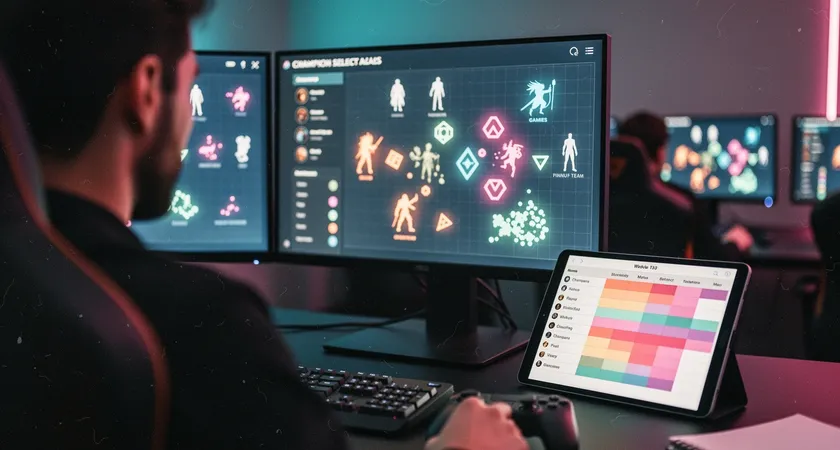
Create Repeatable Early Game Patterns
The opening 10 minutes of a Flex game are not about innovation. They are about executing a small set of rehearsed patterns with extreme precision. Spontaneous, unplanned plays are the biggest source of early deficits for coordinated stacks. Your team needs standard operating procedures for different starting scenarios. These patterns turn ambiguous early game decisions into automatic responses, freeing up mental energy for later improvisation.
Develop a clear protocol for level one. Decide as a team, before queues pop, whether you are invading, defending, or standard leashing. If invading, assign exact positions and spell-ready commands. If defending, assign watch positions and fallback routes. The worst outcome is a split decision where two members invade and three stay behind. Next, establish your first resource priority. Is it a full clear for your jungler to hit level 4, or a three-camp clear into a bot-side gank? This decision dictates lane states for the first few minutes. Your mid and bot lane need to know if they should play for early push or let the wave bounce.
The most impactful pattern is your first objective take. Whether it's Dragon or Rift Herald, the process should be identical every time. At 1:15 before spawn, the shotcaller declares the intention. Supports and junglers synchronize to clear and then establish vision control in the surrounding area. Laners manage their waves to crash into the enemy tower roughly 30 seconds before the objective spawns, granting them a timing window to rotate without losing minions. This coordinated push-and-rotate is what separates a 5-stack from a solo queue team that awkwardly congregates at an objective with no lane priority. Practice this single sequence until it's boring. In ranked, boring and repeatable is powerful.
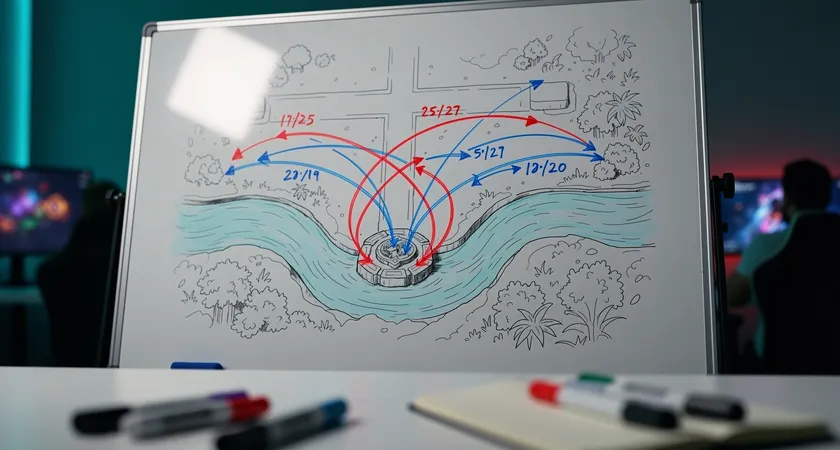
Navigate the Mid-Game Transition as a Single Unit
The period between the first tower falling and the start of true 5v5 sieging is where most Flex teams lose their lead or fail to capitalize on an advantage. This is the map-movement phase. The critical shift is moving from playing your individual lanes to playing the map as a single, five-part unit. The enemy solo queue team will be disorganized here. Your team's ability to move with purpose will create overwhelming pressure.
Adopt the principle of "two lanes of pressure, plus one." After a turret falls, never have all five members in one lane unless you are forcing a decisive fight or taking an inhibitor. The optimal formation is to apply strong pressure in two different lanes, with your jungler (the "plus one") positioned in the river or jungle between them, ready to reinforce either. For example, your bot lane, having taken their tower, rotates to the top lane to push. Simultaneously, your mid-laner shoves the wave in the middle. Your jungler and top laner (now freed up) hover in the top-side jungle. This formation gives you options. If the enemy sends multiple defenders top, you can take a free mid turret or the Rift Herald. If they defend mid weakly, you can dive top with your numerical advantage.
The discipline required is in the reset. Teams often get greedy after a successful push, overstaying to chip at a second turret without vision or resources. Establish a clear reset trigger. It could be after taking one objective (a turret, Herald), when the enemy respawn wave is coming, or when key ultimates are used. The call should be, "We got the top turret, now reset and meet for Dragon in 45." This prevents the classic throw where you gain 1000 gold from a turret but then give away 1500 gold in shutdown kills because you stayed too long. Consistent, incremental advantages win more Flex games than risky, all-or-nothing gambles.
Identify and Break Your Team's Specific Plateaus
After implementing the basics, most teams hit a specific plateau. Progress stalls, and frustration mounts. The issue is rarely a lack of trying. It's usually one or two systemic flaws that have become ingrained habits. Identifying your own team's unique plateau requires moving beyond the post-game "we lost because X fed" analysis and into pattern recognition.
A very common plateau is the Vision Dependency Trap. The team plays well when they have control of the jungle but becomes completely passive and indecisive when behind on vision. They won't leave their bases to regain map control, leading to a slow, strangled loss. The fix is to practice "blind plays" in a safe environment. Designate a player to lead a purposeful, grouped sweep into a quadrant of the jungle to reclaim vision, even if it feels risky. The act of making a decision together, even a suboptimal one, is often better than paralyzing indecision.
Another frequent plateau is Momentum Mismanagement. The team knows how to build a lead but has no protocol for converting it into a closed-out victory. Games drag to 40 minutes, allowing the enemy scaling composition to come online. This is solved by establishing a post-20-minute "checklist." After taking the first mid outer turret, the next three objectives are predetermined: set up Baron vision, use Herald on the other sidelane, then force a fight or take Baron with the created pressure. Having a default late-game roadmap prevents wandering and wasted time.
Breaking these plateaus often requires an external perspective. It's difficult for players inside the game to audit their own communication logs or spot recurring positional errors in teamfights. This is where many teams first consider structured coaching or VOD review services. A skilled reviewer can pinpoint the two or three repeating mistakes that are capping your win rate, providing targeted drills instead of generic advice. The value isn't in being told to "ward more," but in learning exactly where and when your team's vision patterns consistently break down.
Beyond the Basics: When DIY Improvement Isn't Enough
You've defined your identity, built a shotcalling system, and drilled your early patterns. You're climbing, but progress is slow and intermittent. The wins feel good, but the losses are confusing, with the same mistakes seeming to reappear. This is the point where the organic, self-directed learning curve flattens. The issues holding you back are now subtle, ingrained, and invisible to you as participants. Common symptoms include repeated drafting losses against specific compositions, consistent mid-game macro collapses from a winning position, or an inability to adapt when your primary strategy is countered.
At this stage, the return on time invested in just playing more games diminishes sharply. You need diagnostic precision. For example, your team might believe your issue is "bad teamfighting," but a detailed review could reveal the real problem is your engage timing relative to enemy cooldown windows, or your backline's positioning habit that always leaves them flanked. Fixing the root cause requires specific, actionable feedback, not general principles. This is the core challenge of self-coaching. You're trying to diagnose the engine while also driving the car.
Many dedicated 5-stacks reach this juncture and face a choice: continue grinding with unpredictable results, or seek a structured framework for targeted improvement. The latter doesn't necessarily mean a long-term, expensive commitment. It can start with a professional audit of your team's communication, draft history, and key gameplay VODs. An expert eye can often identify the critical, fixable patterns in just a few sessions, providing a clear roadmap for your next 50 games. The goal shifts from playing more to playing smarter, with each session designed to correct a specific, known weakness. For teams serious about maximizing their collective potential in Ranked Flex, this shift from internal guesswork to external, expert-guided process is often the final, and most decisive, strategic play.
Climbing Ranked Flex as a 5-stack is less about individual superstar plays and more about building a reliable machine. That machine runs on clear identity, distributed leadership, practiced patterns, and disciplined map play. Start by committing to one win condition and one draft protocol. Structure your communication to eliminate chaos. Drill your early game until it's automatic. When you hit a wall, have the humility to seek a diagnosis of your specific flaws, not just generic advice. The ranked ladder is full of talented groups. The ones who climb the fastest are the ones who replace improvisation with intention, turning their coordination from a hopeful advantage into a guaranteed one.
FAQ
What's the biggest difference between Flex Queue and Solo/Duo strategy for a 5-man team?
The core difference is predictability. In Solo/Duo, you adapt to strangers. In Flex as a 5-stack, you win by reducing variables. This means creating repeatable systems for draft, early game pathing, and objective takes that your team executes consistently, forcing disorganized opponents to react to your coordinated plays.
Our Flex 5-stack has good mechanics but always loses late-game teamfights. What should we focus on?
Shift focus from mechanics to engagement protocol. Designate one clear voice for fight calls. Practice a simple rule: the engage only happens when your team's key crowd control ultimates are up and the primary enemy damage threat is in range. Record your fights and review not for missed skillshots, but for why the fight was started at that moment. Often, the issue is timing, not execution.
How many champions should each player master for a competitive Flex team pool?
Depth beats breadth. Each player should have 2-3 comfort picks they can play blind into any matchup. As a team, you need 3-4 champion synergy packages drilled, combos like a Jarvan IV jungle with Galio mid. It's better to be experts on 15 champions total as a unit than to have 50 situational picks with no practiced synergy.
How do you deal with one player having a much lower solo queue rank in a Flex 5-stack?
Frame their role strategically. Don't put them on a carry that demands solo outplays. Place them on a low-economy, high-utility champion that supports your team's win condition, like an engage support, a tank top, or a utility mid laner. Use your coordinated vision and rotations to protect their lane from being exploited. Your team's strength should be covering weaknesses, not highlighting them.
What is a good weekly practice schedule for a Flex team trying to climb seriously?
Quality over quantity. Dedicate one session to focused practice, not ranked. Use it to drill one early game pattern or a teamfight combo. Then, schedule 2-3 ranked blocks where you play a set number of games (e.g., 3) with a pre-agreed strategy. Always end with a brief, blameless review of one win and one loss, focusing on a single macro decision, not individual performance.
Our team communication gets noisy and chaotic during high-pressure moments. How can we fix this?
Implement a 'call hierarchy.' Designate specific phases of the game (early, mid, late) to specific voices. Outside of their phase, those players limit comms to essential information only ('flash down'). Practice in normal games with a rule: only the phase-leader and the player with direct information can speak during objective setups. This trains discipline and cuts the noise that causes panic and indecision.